Mzin and I went for a walk in Jackson Park yesterday, for the first time in a couple months the temperatures were hovering a few degrees above freezing, so there was a noticeable change in the air as if everything was just on the verge of changing. For the past while the cedars have been creaking and popping as it gets well below freezing, but yesterday they were in a very silent anticipation. The bird,s however were another matter because they were all over the place, digging under the bark for the insects that were likely also emerging. It was quite cloudy and in some parts foggy, but I think the pictures turned out all right, we were checking out our new camera, a Canon something or other, A710is.
I've been reading Descartes' Discourse on Method over the past few days for a paper I'm writing, and I'm quite disappointed (though not surprised) that he is one of the foundational thinkers of the enlightenment. He quite effectively described our relationship with nature as the ultimate power struggle. Through his text there is a chasm between humanity and the rest of the world, to the point where he assumed everything that had come before his time came about as if by random accidents. This view, though aimed mostly at the ancients, is also directed at the rest of the world, those Wild and whole beings I talked about in my last post. They defied logic.
It really seems to me as if he had been writing as if he were an abandoned child, which is really striking, because he looks to all traditional knowledge as being suspect, possibly because the process of uprooting French traditional thought had been well underway through imperial and religious institutions by his time. Perhaps this process had merely given him the foundation for looking forward instead of backward, forget about doing both at the same time. Institutions are not only keen about the progressive gaze that carries them forward, but they are also keenly fixated on the past, not as an integrated process, say looking forward and backward at the same time, but in a way tends to memorialize the past through monuments and iconic structures that, as Don McKay argues, 'stand against mortality.' The Church and Empires both do this quite effectively, but then along comes Descartes, and seeing ruination everywhere in the past, sees nothing but uncertainty and decay in all things behind, so better to look forward.
In his treatise, Descartes becomes so obsessed with the severance between humanity and nature that he borders on the psychotic. It isn't really much of a surprise that as he is looking forward he finds the clock, a machine, to be a suitable metaphor for all things natural. He does, after all, reject traditional knowledge that might suggest otherwise, so the only reference point that he has to build his vessel to carry him forward is the machine. The psychotic detachment expresses itself in the following quote,
It is also very worthy of remark, that, though there are many animals which manifest more industry than we in certain of their actions, the same animals are yet observed to show none at all in many others: so that the circumstance that they do better than we does not prove that they are endowed with mind, for it would thence follow that they possessed greater reason than any of us, and could surpass us in all things; on the contrary, it rather proves that they are destitute of reason, and that it is nature which acts in them according to the disposition of their organs: thus it is seen, that a clock composed only of wheels and weights can number the hours and measure time more exactly than we with all our skin.
We can trust the clock because it moves along a linear path of cogs and gadgets that are more trustworthy than even our own skin. If properly maintained, a clock can exist long into the future, a straight trajectory that defies age, and the ruination of traditional knowledge... I personally don't buy it, and think the process of uprooting the past, memorializing and making iconic everything that becomes ruins is somewhat of a problem. I think it creates a new foundation in which the secular thought becomes the new religion, and new icons are created. We cannot escape the magnetic pull of an integrated mythic time that allows us to think of the past and future simultaenously. To this extent, I tried looking for it, but cannot find the quote (it may have been Hegel, actually), who said the seed bears the knowledge of the tree it will become. To me, this suggests the progressive path forward toward ultimate enlightenment. But it also neglects that the seed also contains the memory of the tree that went before it. It is both past and future simultaneously.
I also think its important to not mistakes ourselves for God, for one its a bit arrogant, it is also quite a responsibility. Nah, I'd rather take a humbler approach and consider those clever clever machines that is the bigger world around us, to be the gods. Its a good idea to take a step back from time to time and observe, as Descartes did, but then I think its also important to not judge based on experimentation and reason alone, but to just let dreams be as dreams and the world be as the world. Its okay if we don't have the world figured out by grid line after grid line. Who knows, maybe if we observe long enough we'll see that outcasts like Assisi were correct, and that most of the world's highly integrated indigenous belief systems were also correct, that indeed there is intelligence in the world that is outside of humanity, and if anything, it is humanity that could learn the terms of dialogue from the world, instead of perpetually dictating the straight lines of progressive thought back to it.
So, here you are, proof that cars, the machines that house humans, do indeed serve as the best nut crackers (voice over complete with that educated British guy):
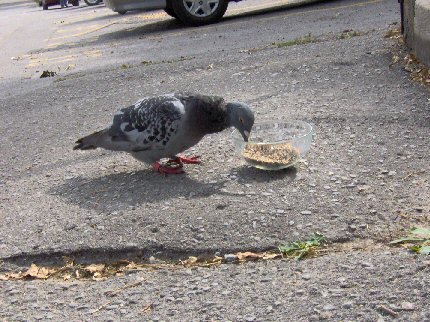
This is the story of CU 558, that's him in the above photograph if anybody is wondering. By posting his image I hope put any rumors that I did not catch a racing pigeon to bed. Anyway, I caught a pigeon, and by doing so have unknowingly exposed myself to the bigger-than-Rick world of Racing pigeons, which if you didn't know, may or may not be bigger-than-yourself in the same way that it is bigger than me.
First of all, context is everything... last friday Renee and I were coming home from errands in town when she noticed a pigeon underneath the mailboxes, "that does not look like any ordinary pigeon," says she. Noticing the tags on it's feet, "I think you're right," says I. So, being inquisitive, I gather some bird seed we feed the Chickadees with, and lure said pigeon to me. As I feed it I'm wary to lunge out and grab it, fearing it might fly away. I do, however, get a glimpse of the tags around it's ankles, "CU 558," and "GUELPH," they read.
After phoning the Peterborough and then Guelph Humane Societies, I am suddenly in touch with an entire network of Pigeon people that are very concerned about the well being of this one bird. Apparently, "CU 558" was one of many pigeons released from the nearby village of Fowler's Corners (where the absolute best Apple pies are made). They should have flown west toward Guelph, which I'm sure many did... except CU 558, who decided the best way to go west would be to go east, find a softy like me who would go out of his way to catch it. So west by east it is.
I managed to catch the pigeon simply by pretending it was a chicken... which are easy to catch if you do it right. So he is now beside me eating his millet, waiting for his ride home this evening.
As I was driving home from Toronto today I noticed the grackles and assorted other birds take part in their annual waves of wings, gathering in the sky and just swarming toward the same direction, it made think of a quote from John Livingston, who in Rogue Primate offers this very lovely passage to portray animals as possessing a unique form of intelligence that may or may not be in the grasp of humanity. The reason I say it may is because these type of things may only occur at the subconcsious level, I say it may not occur among people because of my current dissaproval of many things human at the present. So if things like imperialism and over exploitation are part of some subconscious intelligence among humans, I wish I had been a pigeon instead. Anyway, so Livingston indicates that, yes, indeed, animals think in their unique expressions, like pigeons in flight,
There is awareness involved, and that awareness is shared across the collective participating consciousness of the population concerned.Cues come in to the individual, the group, and the community (mixes of many species are often involved at both ends and during the journeys).Those cues are local interpretations or particular versions of greater regional, continental and planetary promptings.Wild, whole beings would appear to have full sensibility not only to local signs, but also to the greater orchestration which they themselves will now perform.
Wild whole beings sensitive to the bigger-than-Rick orchestrations that guide them from Peterborough to Guelph. Is this what draws people into this practice of letting loose hundreds, sometimes thousands of pigeons? Watch the video I posted below of the two guys in California releasing the pigeons. Its an interesting video because of the before and after action, as well as the child like anticipation and elation in the voice of the camera man. Now, I can see the whole commodification of wild wholebeings in birds like CU 558, after all they are unseen in a metal crate... and my Grandfather told me last night about a racing friend of his who once famously said, "if the bird gets lost it's best if he stays lost because he's obviously not smart enough to find his way home." Obviously this is the ugly side of pigeon racing, commodities to charm, useless if they find their own paths. I'm sure this same type of efficiency is appreciated by all with a cartesian bent that see no inherent value in life other than the value it gives to their pleasure. Everybody I have talked to over the past few days, however, has expressed nothing but compassion for the well being of the bird, and I assume they share the same sentiments as the pigeon racer in California video.
Wild and whole beings that are bigger-than-many-selves when in a group of a thousand eyes and a thousand wings that can only see their way home. Does this mean that CU 558, separated from it's group is somehow less than whole? If one takes the notion of collapse into mind, then maybe yes, CU 588 is less than the whole now that it is separated from it's kin. This makes me think of something my advisor Ray Rogers once said about the Cod fisheries off the Atlantic Coast, yes they have collapsed, but that does not mean the Cod are extinct? No, the cod are still there, but because all of the larger Cod had been swept up for the commercial fisheries, the younger ones that got through the nets were left without the older generations to teach them (or imprint them) with the necessary information to make it to the spawning beds.
I'm not necessarily saying that my friend CU 558 is lacking in any respect, or is less-than-others because he went east instead of west. Instead, he may be showing an even greater-than intelligence by manipulating me into feeding it millet and arranging to have him chauffered to Geulph. West by East.


 This is the story of CU 558, that's him in the above photograph if anybody is wondering. By posting his image I hope put any rumors that I did not catch a racing pigeon to bed. Anyway, I caught a pigeon, and by doing so have unknowingly exposed myself to the bigger-than-Rick world of Racing pigeons, which if you didn't know, may or may not be bigger-than-yourself in the same way that it is bigger than me.


