Showing posts with label Environmental thought. Show all posts

Sunday, March 11, 2007

Jackson's Park, day the before Spring thaw

Mzin and I went for a walk in Jackson Park yesterday, for the first time in a couple months the temperatures were hovering a few degrees above freezing, so there was a noticeable change in the air as if everything was just on the verge of changing. For the past while the cedars have been creaking and popping as it gets well below freezing, but yesterday they were in a very silent anticipation. The bird,s however were another matter because they were all over the place, digging under the bark for the insects that were likely also emerging. It was quite cloudy and in some parts foggy, but I think the pictures turned out all right, we were checking out our new camera, a Canon something or other, A710is.


images by Rick Fehr, 2007 ©, Petrborough, Jackson's Park.

Friday, March 09, 2007

Industrial spirits

There is a very direct dialogue between civilization and the earth occurring at this very moment. Well, its not so much a dialogue as a series of terms being overlaid toward the earth, for at least the past 515 years this discourse has followed the path of greatest resistance, that of imperial trade and political expansionism. This dictate, although secular in its emergence, is entirely spiritual in discourse. After all, Spanish conquistadors dictated the Roman Catholic terms of engagement to Indigenous peoples in Central America in ways that could only be understood in Latin, much to the detriment of the entire populations that did not speak the language. They either learned very quickly or died.

This dialogue, at least from the occidental perspective, occurs on strict linear terms. The discussion follows projections and straight trajectories with very specific ends that very rarely justify the means because the ends very rarely benefits communities. These terms have been quite specifically laid out in grid mentalities and patterns of North American landscape ontology in the 20th century. One specific example of this grid line ontology is the Mississippi River Gulf Outlet and the Industrial Canal of New Orleans, where the way water flows is determined by the quick and easy access of goods, from the coffee I enjoy every morning to the excessive sugar I put in it. Instead of having this delicacy once a month, I am able to enjoy it many times a day, without a second thought of the energy or flow of water that allowed it to fill the empty space that makes my cup. New paths of least resistance are dug from the swamp lands and hydrological nuances that create and recreate land.

Mississippi River Gulf Outlet:
Image: "America's Wetland: Campaign to Save Coastal Louisiana"

The Mississippi River Gulf Outlet (M.R.G.O.) and the Industrial Canal, as straight and narrow as they are, are entirely alien forms to the serpentine ontology of the Mississippi, acting as a syphon draining the millennial process of sedimentation required by the flow of water and sediment from across the Midwest. This is the new least resistance, the lines that allowed Hurricane Katrina a straight and narrow path for the storm surge that topped over into the Lower 9th Ward and Chalmette.

I had a conversation with Jim Igoe in Baton Rouge about linear and cyclical mentality, and how apparent the value of linear thinking over cyclical thinking exacerbated Hurricane Katrina, a disaster many years in the making, all for the cost of cheap coffee, sugar and inexpensive gasoline. Jim offered the premise that cyclical mentality should not necessarily be given absolute priority over linear thought (though there is a great lack of this in Western civilization), but that an intersection or confluence of the two, the convergence of the linear and the cyclical, resembling an internal conch shell, may reveal a more balanced approach to understanding.

Image from 2004, Dr. Rita Cowell ©, "Radiant Equations."
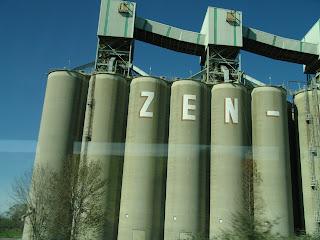
image by Jim Igoe 2007 ©, New Orleans.

I am curious, now, of the amazing intersections that already exist, such as this Zen negative silo, an image of New Orleans that exists through industrial meditation on the movement of water in a world that demands straight lines where there are curves. I am reminded of a recent documentary I watched on spiritual possession in Tibetan Buddhism, in which the narrator described how the first Dalai Lama rose to prominence. Apparently, while making his way through Tibet, the spiritual leader came across many different tribes in many different regions. In the areas he visited, there had been established long standing traditional belief systems based on the nature spirits inhabiting those regions. There were spirits that inhabited river systems, mountains, and forests, and these beings were deeply embedded in the cultural memory of the indigenous populations. On his travels, the Lama conversed with these spirits, wrestled with them, and on occasion enlisted these beings to join him. They are even now revered through the Buddhist oracles in Tibet.

The experience in North, Central and South American colonial expansion has been quite a departure from this exercise. After all, the language used to dictate the terms first came ashore through Latin, Spanish, Portuguese, Dutch, French and English, and not in the languages most familiar to the ears of the Indigenous inhabitants, or as Joe Sheridan and Dan Longboat have said,

"What concession has English made to North America? Why does English, the language that thinks us as much as we think it, continue to structure as imaginary the numinous experiences that happen in the territories beyond its origin? English clear-cuts cultural and biological diversity alike. Speaking only English, can we think our way back to the indigenous languages that are our ancient birthright? Does speaking English or its echo preserve this lousy Weltanschauung?" LINK

In other words, the shape of the land reflects that language that realizes it. However, Katrina offers another response, one that reveals that the land here still does not agree to the terms being dictated to it. Nor does it agree with the straight line ontology that results in MRGO and the Industrial Canal. The terms dictated by Katrina speak more to the syphoning affect years of development have had to the region's natural buffer system, the wetlands, that are continually being flushed into the Gulf of Mexico.

No, the spirits encountered by the first Dalai Lama were not industrial. They were natural and revered by the Indigenous peoples. However, this discussion has never been entertained on a large scale by the colonial visitors to Turtle Island, making the occasion a perpetual visit as opposed to a process of indigenization, one that would have required understanding the terms of the discussion as proposed by the serpentine structure of river systems and the languages used to articulate their stories. The beings that may have been recognized by Indigenous populations like the Houma were likely never even considered in the rush to secure Louisiana first for the Spanish, then the French, the British and the Americans. How could things have been different if a perceptive Frenchman recognized the all encompassing power of the Mississippi, overlaid with the millennial forces that created it and it's environs? Perhaps such a person would have recognized that conversing with this region required a humble approach, one that acknowledges both the cyclical and linear approaches to living within the means of one's environment. Perhaps the Mississippi itself could have confined development along the Old French Quarter as it intended, instead of perpetually flexing the muscles of development to the lowest lying areas.

Instead, the beings that dwell along the Mississippi have enforced a dialogue that can only be understood by Industrial spirits. Such a force is indeed one to be reckoned with, yet such a force becomes immutably small in the face of a counterclockwise wind pushing up straight line mentalities.

Monday, March 05, 2007

New Orleans


I just came back from my trip to Louisiana, where I took the above photograph. Its just a flower, nothing more, nothing less. At one point it was likely cared for under the shade of a welcoming home, by the someone who knew the earth by the hands. The flower is well rooted, as it has found it's way around this pipe, precariously positioned just above it.

I could have placed any number of photographs of New Orleans here, photo's that state 'look at the authentic experience I witnessed, oh the war zone that is the city,' I'm sure many people have done that. I think it is a bit tired now. Yet I am sure many people are engaged in the same process I was, 'people have to see to believe.' Yes, this sentiment is true, but it is also very dangerous. Taking in the scene leads to belief, but it is an entirely fabricated exercise, because too often the tour buses, rented limoscenes and cars are not authentic enough to be included in the frame.

There is a delicate balancing act going on between the blood red lily and the slanted pipe beside, a contrast that maintains itself as if it were the only authenticity needed to convey a particular story, say of a city under a deluge that has been over a century in the fabrication. I wonder, what draws people to the parts of New Orleans that have been most affected by Katrina? Is it because, as Robert Pogue Harrison suggests, the testaments of time and earth that are outside of humanity's grasp are revealed through ruins? Possibly, or is it because we want to fix a part of ourselves that feels alienated from the rest of the world? I like to think it is the former, rather than the latter, but I can easily see how the latter is the case. I found myself taking a few photo's of the tour bus and of the tour group, a reminder that I am not involved in some act of discovery, but I am taking part in something as old as civilization as itself, the continued negotiation between the desires of human development and the lasting memory of nature.

All of this while people still go about living on the other side of the limoscene, a place where the living remind the tourist that they are indeed human beings, just as the tourists are, and that despite how they are portrayed in popular media discourse, that they indeed need basic ammenities such as construction materials, food and water. I find it interesting how the memory of the living is conveniently displaced, relegated to an easy stereotype that seeks to justify neglect. Any metaphor that compares Katrina to an invading army casts the residents as helpless victims of war, removing any agency and autonomy to dictate their own stories, if they so chose to speak them. Popular discourse makes memory easier to convey survivors as hapless victims with no autonomy, they cannot be people who know the earth by the hands, and therefore cannot know or belong to a community. Is this justufying diaspora, the forced displacement of thousands of people with generations of presence in one place?

I think an ounce of empathy can go a mile in erasing this notion. Even further, an ounce of empathy can quickly turn the camera lense on the bus, on the structures and systems that pushed working class black and white New Orleanians to places like the Lower 9th Ward and Chalmette many years ago. These systems feed the discourse, merely out of self preservation. There is a definite structure to this discourse that needs some serious reconsideration. This discourse uses as its foundation the dichotomies of Biblical scripture, conveying stark images of light and dark, there can only be a sublime and an abject. Beauty and squalor are the operative terms, and where there is squalor there can be no little red flower in the foreground, it is a foregone conclusion that there is only despair. This is fabrication, however, and cannot be authenticated when there is a bus behind the lense. We feed like sharks when the latter symbols reveal themselves, it gets the blood going, and reaffirms these dichotomies as we clinically remove ourselves from the scene without a second glance back.

Ruination renews itself through ourselves, and through the authenticity we engineer. This is the same authenticity that pushes back the wetlands and defines the Mississippi River in linear terms to allow the quick and easy flow of goods from the Gulf to the heartland. The linear terms also allow the quick and easy flow of water back to the wetlands when the conditions are right for the wind to turn counterclockwise and contrary to capitalist notions of linearity.

The movement of people onto the wetlands is also a product of this linearity, creating the conditions for people to continue this way of living in the world by draining the wetlands and building communities below sea level. While this may have the appearance of linearity, it is also cyclical in its repetition. Dominant paradigms demand certain conditions to allow civilization to follow its linear projection upward. However, is this an exercise of inclusion or exclusion? Who is included and who is excluded? It was quite apparent in New Orleans who is excluded, in the Lower 9th Ward specifically the issues of race and class are determining factors in this exercise. Yet communities like the Lower 9th Ward defy this projection through their very existence and persistance. Some of the people we spoke to belong to the group "Common Ground Relief", a community based organization that is defying both the dominant paradigms and discourse. Meeting community members here reaffirmed what it was I was doing there. My greatest fear would be that I was contributing to the discourse that conveys New Orleans in the sublime and abject, and that I may have been crafting the story of someone else who had been through a far worse experience than I could ever imagine.

So, instead of revealing more pictures of devastation, I think the image above is adequate for crafting another story from the experience. However, the experience did have my mind replaying a video by Thom Yorke over and over. It is the video for Harrowdown Hill, and portrays quite effectively this broader exercise of crafting narratives of civilization, who is included and excluded, and the shape the world is taking because of this exercise. I see the eagle, obviously fabricated endlessly in the video, as portraying the physical, metaphysical and very tenuous qualities of championing the kind of possessive individualism that demands straight lines in the Mississippi River.


Thursday, October 12, 2006

Something about the way we fall.

An interesting article came my way this morning titled "Imagine the world without humans," from an internet friend I play video games with. Though I guess when we play video games we are occupying a world without humans, because the humans are in their escapist imaginations. Anyway, the article (read it HERE) was in yesterdays online edition of New Scientist, and reads as though it were a Romantic meditation on the sudden absence of humanity, asking the question, 'what would the world look like?' An interesting question, and one that has been asked many many times with many different answers.

There are a couple interesting things I found in the article. For starters, it really downplays the anticipated effects of nuclear radiation, something I was not expecting. The author draws us to look at how ecosystems rebounded following the Chernobyl disaster, both small and large animals (mice and wolves). It would only be speculative for me to to suggest otherwise, because I'm not an expert on nuclear radiation and its effects on ecosystems. Secondly, I found the author's comments on the durability of concrete rather interesting. A quote from a Chernobyl expert notes that the 'most pervasive thing about the structure is how plant life has found it's way through cracks,' further splitting buildings and turning the place into ruins.

I know that during the enlightenment a number of European philosophers (guys like Descartes and Hegel) saw ruined buildings, clogged cities, and what they deemed to be an entirely cluttered landscapes, and they were absolutely petrified. They believed that the mission they were on would prevent humanity from slipping into chaos, that they were literally crafting an accelerated path to progress. History was the space of darkness and ruination and the future was the place of light and reason. The past literally represented that chaotic zone that acted as a vaccuum for all the nations and peoples that got it wrong. I think this idea has a certain amount of hubris to it does not acknowledge what the earth actually does at the end of the day, and that is it reclaims us and everything. This is why I appreciated the author's description of how ecosystems would take on a rather interesting integrated form.

I do have to take a step back from the romantic sentiments of the article and the pull of deep ecology, because I do rather enjoy being alive. However, there is something valuable to consider when we think of what Robert Pogue Harrison meant when he wrote in Dominion of the Dead that built,
architecture actually creates the places where human time, in its historical and existential modes, takes place. Such places - be they homes, buildings, cities or landscapes - are recesses of mortal time in which we go about inhabiting the earth histrocially rather than merely naturally.


As a society, I think Westerners by and large do not meditate on the implications of geological time and what it really represents to humanity. Instead, we've undertaken a process of building as high and as wide as possible, but even Gilgamesh, that first conqueror striving for immortality, had been told that 'Man the highest cannot reach the stars, and man the widest cannot cover the earth.' Of course once he goes beyond the city walls and into the Underworld he realizes that this is true and decides to take a permanent vacation.

Donald Fixico wrote that 'The arms on the clock have a stranglehold on the Indian mind,' and Hakuin wrote that 'from the nothingness there is a path that leads away from the dust of the earth,' but then again Rilke had meditated on these things, "if the earthly has forgotten you, say to the still Earth: I flow. And tell the flowing stream: I am." As a process though, the linear progress of time, the built structures that are meant to eclipse the flow of geological time, in fact, to conquer our own mortality, are the only processes that Western civilization enshrines. The sight of Ruins, Harrison quite rightly notes, fills us with a reflexive and a figurative and literal unsettling experience.

I guess it is appropriate that this article is published in the autumn, maybe the author had an unintended resonance with the Earth's annual reclamation of everything green. After all, he does note how the green reclaims the grey. I took this photo of an Ash (Yellow) and Maple (Red) last weekend when Mzin and I were in Jackson Park.

Friday, October 06, 2006

Cosmic wonder and cosmic blunder

I once heard that is nothing more annoying than having to sit and listen to someone describe a movie you have not seen. Well, maybe that is an exageration, after all, if someone is very visual and can describe scenes in wonderful detail, then I often want to go out and watch the movie myself. I do think there is some truth to the sentiment, however, and know first hand how awkward it can be describing a movie to someone who has not seen it and probably has better things to do then listen to my half-baked description of it.

A couple weeks ago I was in my colloquium and felt myself drawn to a great discussion on the exploitation of nature for medicines, foods, etc... and vice versa the militant preservation of such areas that prohibit people the freedom to use the resources they may have previously enjoyed. Other issues such as bio-piracy and commodification were brought up as well. Many contributors to the discussion were bringing in excellent examples to help the student who initiated the discussion. Various sources and different ways to approach the subject were offered. Well, not wanting to be left out of the discussion (which I absolutely hate, and have to learn to temper myself), I proceed to take one of my points of reference to the discussion, a music video... not even a movie, and proceed to describe the video frame by frame to the class. A music video... When I finished I looked around to notice about a dozen silent faces staring my direction. Needless to say the conversation moved on to another subject. I normally am one who relishes these awkward moments, actually I think its funny even if you initiate awkward moments, its kind of like the temptation one feels as a kid when you have a stick in your hands and your friend rides by on a bicycle. One of those cause and effect situations that throws everything over the handle bars.

Regardless, no one went flying over the handle bars, only the conversation. So, in lieu of a conversation thrown over the handle bars a week and a half ago, I think this might be an appropriate place to offer the video, There There: The Boney King of Nowhere by Radiohead. I find myself often only able to relate to conversations in ways that draw me to story, and this is definately the case with the above conversation. I can think of examples that relate to the discussion, but if I have seen or read a story that has that lyrical and magnetic pull on me, I can only think in similar terms if a discussion develops. My first inclination in the above discussion was to talk about the Welsh stories of the Mabinogion in which similar protocols are offered. I can't recall precisely what story it is, but a King knows of a cosmic cauldron that is guarded over by three giants who sit around in an iron house stirring the pot, I assume looking very much the part of mystical hags and horrid trolls. The King wishes to have access to the cauldron so he can revive his army of 100 dead soldiers. He makes a request of the otherworldly beings, too which they all too happily oblige. Of course, you must thinking, 'there has to be a caveat,' well there always is, right? After being stirred in the massive cauldron, the soldiers are all plucked out one by one, fully alive and aware, but with no memory of their time in the underworld nor in the cauldron of cosmic stew. There is always a caveat... and for the King, he now has 100 soldiers who can neither hear nor speak. There be secrets in the otherworlds beyond our confines of home, family, mortality. But, I think the thing I wanted to get across to the colloguium, and Thom Yorke of Radiohead does this quite wonderfully through his storytelling, as well the Mabinogion and a million other myths articulate quite appropriately both the dangers and the protocols of going there and removing stuff out. Notice how Thom Yorke spies on all the animal families going about their daily business, and how he lurks around from home to home much like a thief, he's looking for something, I like to think he's looking for secret and arcane power. Now notice how when he stumbles across the golden shoes and lab coat, the paradigm suddenly shifts, and the animate world around him looks straight at him not as passive recipients of his gaze, but as 100% tooth and claw.


Sunday, September 24, 2006

Harvest time


Well, first post, not the last, although Nov.11 is approaching. I think this will be a good space to vomit my thoughts into the interworld. Anyway, I think the template looks somewhat classy, all in keeping with the folklorefehr aesthetic. I wondered about the name, but it's been my e-mail handle for a few years now, so why not. After all, I'll likely post some of my rumblings, likely just for my purposes as I work through my PhD... which this is intended to be a record of (my 5 year descend into insanity for anyone who is interested to see). Anyway, I think I need another coffee to get the night cobwebs out, and get the synapses greased.

(goes to get a coffee)

So, I've been commanded by the prof. of my colloquium to write a draft paper on my personal context of inquiry, or what draws me into my research. Being a field that is largely interdisciplinary and directed toward the social sciences, this can mean anything. This can be quite dangerous, and I treat it as such. For me, it can be dangerous because my fear is that the research will become all about me, which it should never be. But, at the same time, you direct your research toward your interests. So I guess I have to find a humbled way of approaching this by taking myself out of the bigger picture of what it is I want to study.

I think a good way to approach it is to research what I am interested, the dissolution of my hometown and the surrounding region (the social, economic and environmental) in the context of the long struggle of resistance throughout Anishinaabe country (namely Bkejwanong Territory - Walpole Island First Nation, next door to my hometown, Wallaceburg). I'm thinking this might actually take on the shape of an environmental and social history of the region... but first I'll need to have sanctioned approval and guidance from the great research community down there. This, along with my team at York University, and who knows. Could be promising.

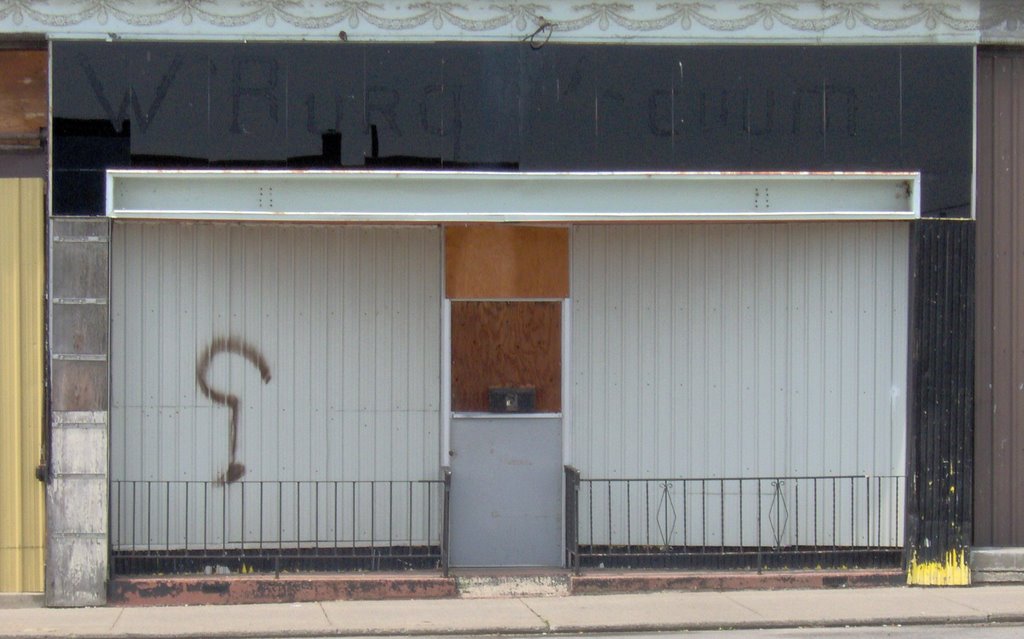
Right now, however, all I can think of is this one image that is indelibly burnt into mind. When I was home this past summer staying at my grandparents (much of the rest of my family has moved off to find work) I did a fair bit of wondering, visited some friends, visited the cemetary to see my good friend Dave who died in summer '05, and just bascially drove around many empty streets. So, I came to the section of town where the first settler supposedly set up a ship building business on the Sydenham River, and low and behold the only businesses around happened to be a taxi stand, a senior's complex, an oddly situated bar, a mechanic and a strip joint. I guess there are businesses now that I think about it, but there are probably just as many empty storefronts as well, a number of which are boarded up with just the sun burnt letters where there signs were previously. Graffiti has been splashed on many of the wallas and storefronts, but its not the graffiti I've come to expect from unknown artistic masters, instead its from the same hand, with nothing more than a question to ask. What is most fascinating though is that even the question has come out distorted, a backwards "?" making it look eerily like a sickle. I think Mora, my colloguium prof will appreciate the inclusion of this image in my paper tomorrow...