I have to say, I have a new found appetite for bugs after watching the chimps in this video artfully 'fish' for termites. Yet the best part about the video is how the researchers turned into instant wrecks when they tried it. Of course, being National Geographic, the announcer has to make the obvious connection between fishing for termites and chimps forging weapons (which they would no doubt use to hunt Wooly Mammoths).
NATIONAL GEOGRAPHIC
Friday, March 21, 2008


Wednesday, March 19, 2008
Small White Lady's Slipper
This is the draft video I put together of the Small White Lady's Slipper on Bkejwanong Territory. I believe the community holds the largest population in Canada, and is one of two or three sites in Ontario. You'll notice how severe shoreline erosion is to the plant. The most ironic part about the situation is how the invasive phragmites plant is actually holding parts of the shore (and the plants) in place. Phragmites is taking over like wildfire, and indeed is the source of massive wildfires in the spring. The plant has long tendril roots, which you'll see, and does not allow much else (waterfowl, indigenous reeds, prairie flowers, etc...) to grow.
Music is "Salka" by Sigur-Ros.
Music is "Salka" by Sigur-Ros.
Saturday, February 09, 2008
a post!
I watched the video produced by Amanda Baggs about a week ago, and I've been thinking about it ever since. Specifically, it reminded me of a couple things. Firstly, I recalled a line from Gaston Bachelard's book Water and Dreams in which he makes the argument that people who live near water all their life, know the water as a poetic reality, rather than as a determined, and I might say, a strict linear quality. Secondly, I was reminded of when I shared some of my research with a friend (perhaps a bit too enthusiastically), only to find he just didn't get what I was trying to say. The frustration arose when I tried to suggest that an animated experience of reality can allow for the presence of what some Anthropologists (Hallowell, Ingold) consider the other-than-human beings that fill old stories and mythology. This potential, or possibility, arises through a communication with the world that defies the strict edicts of what the modern world considers communication. The communication does not have to be expressed in English, on television, or on the internet, but I like to think it comes from the experience of being here and listening and the repetition of this. It may be in thunderclouds that are other-than mere meteorological phenomena or it may be in snowfall that is other-than frozen crystalized precipitation. I like to think of these things as Bachelard, as the poetic realities, that if we're fortunate enough may find words not easily distilled in English, the poetic realities that move us to engage with the world in anti-modern dialogue.
Saturday, July 21, 2007
Chipmunk
A chipmunk that often comes through backyard looking for food, thought I'd give him some bird seed... he has plenty of scars from previous scraps with other chipmunks and maybe the number of cats that harrass him.
Storm in Chatham
My friend April filmed this storm in her backyard, reminds me of the torrential rainstorms I remember, waves of water coming in horizontally. It's kind of scary how we'll get week after week of bone dry baking heat, and then snap!
Monday, April 16, 2007
Big wings
I've been somewhat hesitant to post anything other than the occasional set of photos on my blog over the past month, without it appearing to be further wallowing in the hopeless and subtle anxiety I've felt since returning from New Orleans. The tailspin continues, but I wanted to stress through my past couple posts (and others I may have made but erased) that hope comes through in little signs, and further, that the feeling of hopelessness can be contextualized from other people who feel the same way I do about social and environmental injustice. Sometimes the people who share these things with you do so without you realizing. Only afterwards, after reflection and meditation do the measures of hope add up. For instance, Jim Igoe, the anthropologist I stayed with Baton Rouge, concluded an article with an interesting thought that I had first dismissed as stretching to find a silver lining. In his article, (Anthropology News, December 2006), we see the transformation of the landscapes and people of New Orleans from communities of human beings (and to that extend I would add 'communities of non-human beings') from people with agency to the classical romantic dichotomy of dark (abject) entities while the viewer implicitly occupies attributes of transcendence (the sublime) by maintaining the safety of escape from the despair that is at hand. Now, what I had dismissed before comes back as a means of fully appreciating hope and hopelessness, as Igoe states,
These transformations have obvious and significant implications for the ways in which we conceptualize human rights and social justice. Social scientists have an important role in this reconceptualization. A large part of this role is to better understand the nature of the order that I have briefly described here, as part of its nature is to conceal its nature. An equally crucial element of this role will hinge upon our effectiveness at communicating our insights and recommendations to the broader public and decision-makers.
The nature of this order he speaks of should raise concern in everyone, as it is has become in a sense a new nature, as elusive as that nature that led John Muir to the heights of an ancient redwood in the middle of a thunderstorm where he could come face to face with God in the raw. The storm he came face to face with likely concealed its nature to him, giving him an elusive flirt that could only reveal itself at his death, for the real nature of his being had been abandoned with his wife and children who waited patiently for him at home. They were shut out for that which expressed its pure sublimity. As William Cronon suggests in his paper The Trouble with Wilderness, could that same connection with something bigger not be found in our backyards? Must we fly and view these things from the safety of glass?
Indeed these things need to be reconceputalized.
I think of a story told about the creation of a particular river I grew up near, and the all-encompassing immensity of water it holds enroute to the ocean. That river, which I knew as a kid as the place to get the best perch as they too were carried down from Lake Huron, enroute to my stomach, is also a troubled river, as it also carries the weight of heavy metals and a very unbio-diverse array of chemicals from the appropriately named Chemical Valley in Sarnia. This story, though it may not be appropriately be shared here, would have likely resonated with German philosopher Walter Benjamin, who died under suspicious circumstances whilst being pursued by Nazis. In his wonderful essay Philosophy of History, Benjamin meditates on a work of art by Paul Klees, Angelus Novus:

Benjamin writes of the ordering of history through this Being with its wings, and states:
His eyes are staring, his mouth is open, his wings are spread. This is how one pictures the angel of history. His face is turned toward the past. Where we perceive a chain of events, he sees one single catastrophe which keeps piling wreckage upon wreckage and hurls it in front of his feet. The angel would like to stay, awaken the dead, and make whole what has been smashed. But a storm is blowing from paradise; it has got caught in his wings with such violence that the angel can no longer close them. This storm irresistibly propels him into the future to which his back is turned, while the pile of debris before him grows skyward. This storm is what we call progress.
This storm we call progress has been piling things high on rivers in a relatively short span of history that is meant to be transcendental. Perhaps the basis of hope is found in the reordering of a type of thought that dictates historical progression is the only way to move forward. Perhaps becoming trapped in thisprogression of thought allows us to be either co-opted into it or lost to all in despair. I like to think there is hope, a way of thinking that asks us to reconsider the nature of imperialism and mass-consumption, and that indeed those things of beauty are also in our backyard... like the chickadees that nest in our backyard. They too can order our thoughts in ways that don't turn entire worlds upside-down and shake them up end over end as the storm of progress... simplicity.
These transformations have obvious and significant implications for the ways in which we conceptualize human rights and social justice. Social scientists have an important role in this reconceptualization. A large part of this role is to better understand the nature of the order that I have briefly described here, as part of its nature is to conceal its nature. An equally crucial element of this role will hinge upon our effectiveness at communicating our insights and recommendations to the broader public and decision-makers.
The nature of this order he speaks of should raise concern in everyone, as it is has become in a sense a new nature, as elusive as that nature that led John Muir to the heights of an ancient redwood in the middle of a thunderstorm where he could come face to face with God in the raw. The storm he came face to face with likely concealed its nature to him, giving him an elusive flirt that could only reveal itself at his death, for the real nature of his being had been abandoned with his wife and children who waited patiently for him at home. They were shut out for that which expressed its pure sublimity. As William Cronon suggests in his paper The Trouble with Wilderness, could that same connection with something bigger not be found in our backyards? Must we fly and view these things from the safety of glass?
Indeed these things need to be reconceputalized.
I think of a story told about the creation of a particular river I grew up near, and the all-encompassing immensity of water it holds enroute to the ocean. That river, which I knew as a kid as the place to get the best perch as they too were carried down from Lake Huron, enroute to my stomach, is also a troubled river, as it also carries the weight of heavy metals and a very unbio-diverse array of chemicals from the appropriately named Chemical Valley in Sarnia. This story, though it may not be appropriately be shared here, would have likely resonated with German philosopher Walter Benjamin, who died under suspicious circumstances whilst being pursued by Nazis. In his wonderful essay Philosophy of History, Benjamin meditates on a work of art by Paul Klees, Angelus Novus:

Benjamin writes of the ordering of history through this Being with its wings, and states:
His eyes are staring, his mouth is open, his wings are spread. This is how one pictures the angel of history. His face is turned toward the past. Where we perceive a chain of events, he sees one single catastrophe which keeps piling wreckage upon wreckage and hurls it in front of his feet. The angel would like to stay, awaken the dead, and make whole what has been smashed. But a storm is blowing from paradise; it has got caught in his wings with such violence that the angel can no longer close them. This storm irresistibly propels him into the future to which his back is turned, while the pile of debris before him grows skyward. This storm is what we call progress.
This storm we call progress has been piling things high on rivers in a relatively short span of history that is meant to be transcendental. Perhaps the basis of hope is found in the reordering of a type of thought that dictates historical progression is the only way to move forward. Perhaps becoming trapped in thisprogression of thought allows us to be either co-opted into it or lost to all in despair. I like to think there is hope, a way of thinking that asks us to reconsider the nature of imperialism and mass-consumption, and that indeed those things of beauty are also in our backyard... like the chickadees that nest in our backyard. They too can order our thoughts in ways that don't turn entire worlds upside-down and shake them up end over end as the storm of progress... simplicity.
Tuesday, March 13, 2007
Sunday, March 11, 2007
Jackson's Park, day the before Spring thaw
Mzin and I went for a walk in Jackson Park yesterday, for the first time in a couple months the temperatures were hovering a few degrees above freezing, so there was a noticeable change in the air as if everything was just on the verge of changing. For the past while the cedars have been creaking and popping as it gets well below freezing, but yesterday they were in a very silent anticipation. The bird,s however were another matter because they were all over the place, digging under the bark for the insects that were likely also emerging. It was quite cloudy and in some parts foggy, but I think the pictures turned out all right, we were checking out our new camera, a Canon something or other, A710is.

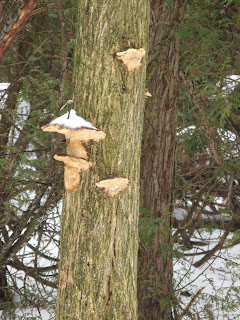
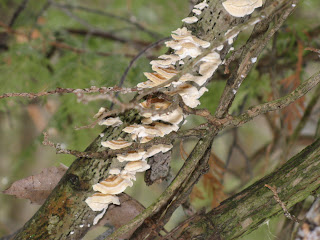
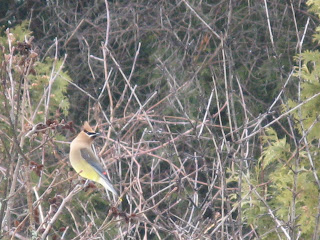
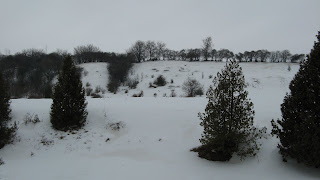

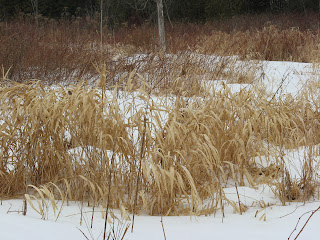
images by Rick Fehr, 2007 ©, Petrborough, Jackson's Park.


images by Rick Fehr, 2007 ©, Petrborough, Jackson's Park.
Friday, March 09, 2007
Industrial spirits
There is a very direct dialogue between civilization and the earth occurring at this very moment. Well, its not so much a dialogue as a series of terms being overlaid toward the earth, for at least the past 515 years this discourse has followed the path of greatest resistance, that of imperial trade and political expansionism. This dictate, although secular in its emergence, is entirely spiritual in discourse. After all, Spanish conquistadors dictated the Roman Catholic terms of engagement to Indigenous peoples in Central America in ways that could only be understood in Latin, much to the detriment of the entire populations that did not speak the language. They either learned very quickly or died.
This dialogue, at least from the occidental perspective, occurs on strict linear terms. The discussion follows projections and straight trajectories with very specific ends that very rarely justify the means because the ends very rarely benefits communities. These terms have been quite specifically laid out in grid mentalities and patterns of North American landscape ontology in the 20th century. One specific example of this grid line ontology is the Mississippi River Gulf Outlet and the Industrial Canal of New Orleans, where the way water flows is determined by the quick and easy access of goods, from the coffee I enjoy every morning to the excessive sugar I put in it. Instead of having this delicacy once a month, I am able to enjoy it many times a day, without a second thought of the energy or flow of water that allowed it to fill the empty space that makes my cup. New paths of least resistance are dug from the swamp lands and hydrological nuances that create and recreate land.
Mississippi River Gulf Outlet:
 Image: "America's Wetland: Campaign to Save Coastal Louisiana"
The Mississippi River Gulf Outlet (M.R.G.O.) and the Industrial Canal, as straight and narrow as they are, are entirely alien forms to the serpentine ontology of the Mississippi, acting as a syphon draining the millennial process of sedimentation required by the flow of water and sediment from across the Midwest. This is the new least resistance, the lines that allowed Hurricane Katrina a straight and narrow path for the storm surge that topped over into the Lower 9th Ward and Chalmette.
I had a conversation with Jim Igoe in Baton Rouge about linear and cyclical mentality, and how apparent the value of linear thinking over cyclical thinking exacerbated Hurricane Katrina, a disaster many years in the making, all for the cost of cheap coffee, sugar and inexpensive gasoline. Jim offered the premise that cyclical mentality should not necessarily be given absolute priority over linear thought (though there is a great lack of this in Western civilization), but that an intersection or confluence of the two, the convergence of the linear and the cyclical, resembling an internal conch shell, may reveal a more balanced approach to understanding.
 Image from 2004, Dr. Rita Cowell ©, "Radiant Equations."
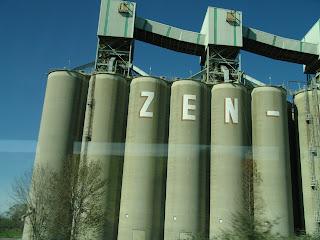 image by Jim Igoe 2007 ©, New Orleans.
I am curious, now, of the amazing intersections that already exist, such as this Zen negative silo, an image of New Orleans that exists through industrial meditation on the movement of water in a world that demands straight lines where there are curves. I am reminded of a recent documentary I watched on spiritual possession in Tibetan Buddhism, in which the narrator described how the first Dalai Lama rose to prominence. Apparently, while making his way through Tibet, the spiritual leader came across many different tribes in many different regions. In the areas he visited, there had been established long standing traditional belief systems based on the nature spirits inhabiting those regions. There were spirits that inhabited river systems, mountains, and forests, and these beings were deeply embedded in the cultural memory of the indigenous populations. On his travels, the Lama conversed with these spirits, wrestled with them, and on occasion enlisted these beings to join him. They are even now revered through the Buddhist oracles in Tibet.
The experience in North, Central and South American colonial expansion has been quite a departure from this exercise. After all, the language used to dictate the terms first came ashore through Latin, Spanish, Portuguese, Dutch, French and English, and not in the languages most familiar to the ears of the Indigenous inhabitants, or as Joe Sheridan and Dan Longboat have said,
"What concession has English made to North America? Why does English, the language that thinks us as much as we think it, continue to structure as imaginary the numinous experiences that happen in the territories beyond its origin? English clear-cuts cultural and biological diversity alike. Speaking only English, can we think our way back to the indigenous languages that are our ancient birthright? Does speaking English or its echo preserve this lousy Weltanschauung?" LINK
In other words, the shape of the land reflects that language that realizes it. However, Katrina offers another response, one that reveals that the land here still does not agree to the terms being dictated to it. Nor does it agree with the straight line ontology that results in MRGO and the Industrial Canal. The terms dictated by Katrina speak more to the syphoning affect years of development have had to the region's natural buffer system, the wetlands, that are continually being flushed into the Gulf of Mexico.
No, the spirits encountered by the first Dalai Lama were not industrial. They were natural and revered by the Indigenous peoples. However, this discussion has never been entertained on a large scale by the colonial visitors to Turtle Island, making the occasion a perpetual visit as opposed to a process of indigenization, one that would have required understanding the terms of the discussion as proposed by the serpentine structure of river systems and the languages used to articulate their stories. The beings that may have been recognized by Indigenous populations like the Houma were likely never even considered in the rush to secure Louisiana first for the Spanish, then the French, the British and the Americans. How could things have been different if a perceptive Frenchman recognized the all encompassing power of the Mississippi, overlaid with the millennial forces that created it and it's environs? Perhaps such a person would have recognized that conversing with this region required a humble approach, one that acknowledges both the cyclical and linear approaches to living within the means of one's environment. Perhaps the Mississippi itself could have confined development along the Old French Quarter as it intended, instead of perpetually flexing the muscles of development to the lowest lying areas.
Instead, the beings that dwell along the Mississippi have enforced a dialogue that can only be understood by Industrial spirits. Such a force is indeed one to be reckoned with, yet such a force becomes immutably small in the face of a counterclockwise wind pushing up straight line mentalities.
This dialogue, at least from the occidental perspective, occurs on strict linear terms. The discussion follows projections and straight trajectories with very specific ends that very rarely justify the means because the ends very rarely benefits communities. These terms have been quite specifically laid out in grid mentalities and patterns of North American landscape ontology in the 20th century. One specific example of this grid line ontology is the Mississippi River Gulf Outlet and the Industrial Canal of New Orleans, where the way water flows is determined by the quick and easy access of goods, from the coffee I enjoy every morning to the excessive sugar I put in it. Instead of having this delicacy once a month, I am able to enjoy it many times a day, without a second thought of the energy or flow of water that allowed it to fill the empty space that makes my cup. New paths of least resistance are dug from the swamp lands and hydrological nuances that create and recreate land.
Mississippi River Gulf Outlet:
 Image: "America's Wetland: Campaign to Save Coastal Louisiana"
The Mississippi River Gulf Outlet (M.R.G.O.) and the Industrial Canal, as straight and narrow as they are, are entirely alien forms to the serpentine ontology of the Mississippi, acting as a syphon draining the millennial process of sedimentation required by the flow of water and sediment from across the Midwest. This is the new least resistance, the lines that allowed Hurricane Katrina a straight and narrow path for the storm surge that topped over into the Lower 9th Ward and Chalmette.
I had a conversation with Jim Igoe in Baton Rouge about linear and cyclical mentality, and how apparent the value of linear thinking over cyclical thinking exacerbated Hurricane Katrina, a disaster many years in the making, all for the cost of cheap coffee, sugar and inexpensive gasoline. Jim offered the premise that cyclical mentality should not necessarily be given absolute priority over linear thought (though there is a great lack of this in Western civilization), but that an intersection or confluence of the two, the convergence of the linear and the cyclical, resembling an internal conch shell, may reveal a more balanced approach to understanding.
 Image from 2004, Dr. Rita Cowell ©, "Radiant Equations."
 image by Jim Igoe 2007 ©, New Orleans.
I am curious, now, of the amazing intersections that already exist, such as this Zen negative silo, an image of New Orleans that exists through industrial meditation on the movement of water in a world that demands straight lines where there are curves. I am reminded of a recent documentary I watched on spiritual possession in Tibetan Buddhism, in which the narrator described how the first Dalai Lama rose to prominence. Apparently, while making his way through Tibet, the spiritual leader came across many different tribes in many different regions. In the areas he visited, there had been established long standing traditional belief systems based on the nature spirits inhabiting those regions. There were spirits that inhabited river systems, mountains, and forests, and these beings were deeply embedded in the cultural memory of the indigenous populations. On his travels, the Lama conversed with these spirits, wrestled with them, and on occasion enlisted these beings to join him. They are even now revered through the Buddhist oracles in Tibet.
The experience in North, Central and South American colonial expansion has been quite a departure from this exercise. After all, the language used to dictate the terms first came ashore through Latin, Spanish, Portuguese, Dutch, French and English, and not in the languages most familiar to the ears of the Indigenous inhabitants, or as Joe Sheridan and Dan Longboat have said,
"What concession has English made to North America? Why does English, the language that thinks us as much as we think it, continue to structure as imaginary the numinous experiences that happen in the territories beyond its origin? English clear-cuts cultural and biological diversity alike. Speaking only English, can we think our way back to the indigenous languages that are our ancient birthright? Does speaking English or its echo preserve this lousy Weltanschauung?" LINK
In other words, the shape of the land reflects that language that realizes it. However, Katrina offers another response, one that reveals that the land here still does not agree to the terms being dictated to it. Nor does it agree with the straight line ontology that results in MRGO and the Industrial Canal. The terms dictated by Katrina speak more to the syphoning affect years of development have had to the region's natural buffer system, the wetlands, that are continually being flushed into the Gulf of Mexico.
No, the spirits encountered by the first Dalai Lama were not industrial. They were natural and revered by the Indigenous peoples. However, this discussion has never been entertained on a large scale by the colonial visitors to Turtle Island, making the occasion a perpetual visit as opposed to a process of indigenization, one that would have required understanding the terms of the discussion as proposed by the serpentine structure of river systems and the languages used to articulate their stories. The beings that may have been recognized by Indigenous populations like the Houma were likely never even considered in the rush to secure Louisiana first for the Spanish, then the French, the British and the Americans. How could things have been different if a perceptive Frenchman recognized the all encompassing power of the Mississippi, overlaid with the millennial forces that created it and it's environs? Perhaps such a person would have recognized that conversing with this region required a humble approach, one that acknowledges both the cyclical and linear approaches to living within the means of one's environment. Perhaps the Mississippi itself could have confined development along the Old French Quarter as it intended, instead of perpetually flexing the muscles of development to the lowest lying areas.
Instead, the beings that dwell along the Mississippi have enforced a dialogue that can only be understood by Industrial spirits. Such a force is indeed one to be reckoned with, yet such a force becomes immutably small in the face of a counterclockwise wind pushing up straight line mentalities.
Monday, March 05, 2007
New Orleans

I just came back from my trip to Louisiana, where I took the above photograph. Its just a flower, nothing more, nothing less. At one point it was likely cared for under the shade of a welcoming home, by the someone who knew the earth by the hands. The flower is well rooted, as it has found it's way around this pipe, precariously positioned just above it.
I could have placed any number of photographs of New Orleans here, photo's that state 'look at the authentic experience I witnessed, oh the war zone that is the city,' I'm sure many people have done that. I think it is a bit tired now. Yet I am sure many people are engaged in the same process I was, 'people have to see to believe.' Yes, this sentiment is true, but it is also very dangerous. Taking in the scene leads to belief, but it is an entirely fabricated exercise, because too often the tour buses, rented limoscenes and cars are not authentic enough to be included in the frame.
There is a delicate balancing act going on between the blood red lily and the slanted pipe beside, a contrast that maintains itself as if it were the only authenticity needed to convey a particular story, say of a city under a deluge that has been over a century in the fabrication. I wonder, what draws people to the parts of New Orleans that have been most affected by Katrina? Is it because, as Robert Pogue Harrison suggests, the testaments of time and earth that are outside of humanity's grasp are revealed through ruins? Possibly, or is it because we want to fix a part of ourselves that feels alienated from the rest of the world? I like to think it is the former, rather than the latter, but I can easily see how the latter is the case. I found myself taking a few photo's of the tour bus and of the tour group, a reminder that I am not involved in some act of discovery, but I am taking part in something as old as civilization as itself, the continued negotiation between the desires of human development and the lasting memory of nature.
All of this while people still go about living on the other side of the limoscene, a place where the living remind the tourist that they are indeed human beings, just as the tourists are, and that despite how they are portrayed in popular media discourse, that they indeed need basic ammenities such as construction materials, food and water. I find it interesting how the memory of the living is conveniently displaced, relegated to an easy stereotype that seeks to justify neglect. Any metaphor that compares Katrina to an invading army casts the residents as helpless victims of war, removing any agency and autonomy to dictate their own stories, if they so chose to speak them. Popular discourse makes memory easier to convey survivors as hapless victims with no autonomy, they cannot be people who know the earth by the hands, and therefore cannot know or belong to a community. Is this justufying diaspora, the forced displacement of thousands of people with generations of presence in one place?
I think an ounce of empathy can go a mile in erasing this notion. Even further, an ounce of empathy can quickly turn the camera lense on the bus, on the structures and systems that pushed working class black and white New Orleanians to places like the Lower 9th Ward and Chalmette many years ago. These systems feed the discourse, merely out of self preservation. There is a definite structure to this discourse that needs some serious reconsideration. This discourse uses as its foundation the dichotomies of Biblical scripture, conveying stark images of light and dark, there can only be a sublime and an abject. Beauty and squalor are the operative terms, and where there is squalor there can be no little red flower in the foreground, it is a foregone conclusion that there is only despair. This is fabrication, however, and cannot be authenticated when there is a bus behind the lense. We feed like sharks when the latter symbols reveal themselves, it gets the blood going, and reaffirms these dichotomies as we clinically remove ourselves from the scene without a second glance back.
Ruination renews itself through ourselves, and through the authenticity we engineer. This is the same authenticity that pushes back the wetlands and defines the Mississippi River in linear terms to allow the quick and easy flow of goods from the Gulf to the heartland. The linear terms also allow the quick and easy flow of water back to the wetlands when the conditions are right for the wind to turn counterclockwise and contrary to capitalist notions of linearity.
The movement of people onto the wetlands is also a product of this linearity, creating the conditions for people to continue this way of living in the world by draining the wetlands and building communities below sea level. While this may have the appearance of linearity, it is also cyclical in its repetition. Dominant paradigms demand certain conditions to allow civilization to follow its linear projection upward. However, is this an exercise of inclusion or exclusion? Who is included and who is excluded? It was quite apparent in New Orleans who is excluded, in the Lower 9th Ward specifically the issues of race and class are determining factors in this exercise. Yet communities like the Lower 9th Ward defy this projection through their very existence and persistance. Some of the people we spoke to belong to the group "Common Ground Relief", a community based organization that is defying both the dominant paradigms and discourse. Meeting community members here reaffirmed what it was I was doing there. My greatest fear would be that I was contributing to the discourse that conveys New Orleans in the sublime and abject, and that I may have been crafting the story of someone else who had been through a far worse experience than I could ever imagine.
So, instead of revealing more pictures of devastation, I think the image above is adequate for crafting another story from the experience. However, the experience did have my mind replaying a video by Thom Yorke over and over. It is the video for Harrowdown Hill, and portrays quite effectively this broader exercise of crafting narratives of civilization, who is included and excluded, and the shape the world is taking because of this exercise. I see the eagle, obviously fabricated endlessly in the video, as portraying the physical, metaphysical and very tenuous qualities of championing the kind of possessive individualism that demands straight lines in the Mississippi River.
Tuesday, February 13, 2007
That which is much bigger II
There is a moment in the Mabinogion when Gwydion, trickster and uncle to the Welsh hero Llew Lagh Gyffes, must enter the underworld to find his lost nephew. This is my favorite moment in the story, because in an instant, Gwydion disappears into the earth as he chases a mysterious pig that flees from his pen every morning. This animal leads him to a broad river, which in turn leads him to his nephew. This moment is fairly significant, as it charts the cosmogenic elements of the Welsh, one that I cannot relay, but one that weaves its way through your entire being.
A group of my students gave a presentation on water as a sacred element and water as a commodified resource. They were very articulate in their religious depictions of water, offering examples of how water is sacred element from a Judaic, Muslim and Christian background, and how the sacred essence that these traditions convey are greatly diminished when water is bottled. One student commented that, 'the sacred essence of water leaves when it is left standing and concealed' in a bottle. I appreciated this sentiment, and I think Gwydion would as well, for the river he follows is moving considerably, just as the pig that leads him on. There is a sense of uncontained movement, or as Steve Martin and John Candy once noted, Martin: "I know, I know, just go with the flow," Candy: "Like a twig on the current of a mighty stream."
I offered my students another perspective on water, this one from Stephen Mitchell's translation of the Tao Te Ching
15
The ancient Masters were profound and subtle.
Their wisdom was unfathomable.
There is no way to describe it;
all we can describe is their appearance.
They were careful
as someone crossing an iced-over stream.
Alert as a warrior in enemy territory.
Courteous as a guest.
Fluid as melting ice.
Shapable as a block of wood.
Receptive as a valley.
Clear as a glass of water.
Do you have the patience to wait
till your mud settles and the water is clear?
Can you remain unmoving
till the right action arises by itself?
The Master doesn't seek fulfillment.
Not seeking, not expecting,
she is present, and can welcome all things.
I think they appreciated the subtlety of the Tao and its dual descriptions of movement and stillness, and how both are elements of water. I also told them of a Buddhist saying, "all boats lead to the same shore." The last quote is quite revealing about the role of water, and the vessels we use to navigate it. To exemplify the tradition this last sentiment comes from, I found a trailer to a film I really want to see, Dharma River, which seems quite evocative to me of the movement of water and people.
A group of my students gave a presentation on water as a sacred element and water as a commodified resource. They were very articulate in their religious depictions of water, offering examples of how water is sacred element from a Judaic, Muslim and Christian background, and how the sacred essence that these traditions convey are greatly diminished when water is bottled. One student commented that, 'the sacred essence of water leaves when it is left standing and concealed' in a bottle. I appreciated this sentiment, and I think Gwydion would as well, for the river he follows is moving considerably, just as the pig that leads him on. There is a sense of uncontained movement, or as Steve Martin and John Candy once noted, Martin: "I know, I know, just go with the flow," Candy: "Like a twig on the current of a mighty stream."
I offered my students another perspective on water, this one from Stephen Mitchell's translation of the Tao Te Ching
15
The ancient Masters were profound and subtle.
Their wisdom was unfathomable.
There is no way to describe it;
all we can describe is their appearance.
They were careful
as someone crossing an iced-over stream.
Alert as a warrior in enemy territory.
Courteous as a guest.
Fluid as melting ice.
Shapable as a block of wood.
Receptive as a valley.
Clear as a glass of water.
Do you have the patience to wait
till your mud settles and the water is clear?
Can you remain unmoving
till the right action arises by itself?
The Master doesn't seek fulfillment.
Not seeking, not expecting,
she is present, and can welcome all things.
I think they appreciated the subtlety of the Tao and its dual descriptions of movement and stillness, and how both are elements of water. I also told them of a Buddhist saying, "all boats lead to the same shore." The last quote is quite revealing about the role of water, and the vessels we use to navigate it. To exemplify the tradition this last sentiment comes from, I found a trailer to a film I really want to see, Dharma River, which seems quite evocative to me of the movement of water and people.
Tuesday, February 06, 2007
That which is much bigger
Stephen Mitchell writes a wonderful introduction to the 2000 translation of the Bhagavad Gita (LINK), in which Mitchell asks the reader to consider the story as taking place before a great battle (as it does), but to imagine a great event unfolding in that one moment before battle when the adrenaline is high and when both sides survey the opposing force in those moments of fear and uncertainty. In that moment, Mitchell suggests,
everything is still. The armies have halted in their tracks. Even the flies are caught in midair between two wingbeats. The vast moving picture of reality stops on a single frame, as in Borge's story "The Secret Miracle." The moment of the poem has expanded beyond time, and the only characters who continue, earnestly discoursing between the silent, frozen armies, are Arjuna and Krishna.
Krishna, of course, happens to be much more than Arjuna's Charioteer, he is also God. He picks a fairly significant moment to reveal the cosmos to the hero. 'Whether or not he should fight,' says Mitchell,' is secondary to the question he faces through Krishna, and that is, 'how should we live?'
At his lowest moment, Arjuna crumbles from the pressure, and Krishna teaches him about being, and in closing, Krishna speaks of wisdom, sacrifice, of facing that which needs facing and letting go that which needs letting go,
The man whom desires enter
as rivers flow into the sea,
filled yet always unmoving -
that man finds perfect peace.
There are moments like this, when the veil between the profane and that which is much bigger is revealed, if even between the wingbeats of a fly. I recall reading a couple of years ago that serves a similar role. It was by an anyonomous author about a river near where I grew up, the Snye, which at one time was known as the Chenal Ecarte (which in French means the Lost or Blind Channel). This also happens to be the river I centered my Masters research on, so it was nice to find that someone, some settler perhaps, dreamt of this river as I did, as something much bigger. The poem appears in Frank Mann's 1968 book A History of Wallaceburg and Vicinity,
Chenal Ecarte
(the Lost channel)
Bright, eddying, shimmering, current.
Have you really lost your way?
From the course of common torrent,
Of the lake, the river, bay?
Men call you "Waif stretch of water,
That has run from other astray,
Your Neptune, the old Sea God's daughter,
A madcap, so blithesome and bray"
We've drifted with boat songs as lovers,
Gay, heedless of rudder or sail,
We have whistled to keep up our courage,
When the breezes were blowing a gale.
Thru' marshland and glade we have wondered,
The sport of the winds and tide
The days of that light childhood laughter
Are lost in the gulf deep and wide.
I'm drifting from my moorings, fair water,
From the banks that in childhood I plied,
I'm drifting on Time's swift flowing river,
And needful as you are my guide.
We are both sweeping to the ocean,
Through channels chance fortune has made,
We shall fade at last in its bosom
As inifinities in infinate fade.
Only someone kin to Arjuna could appreciate the Chenal Ecarte, in that one moment you are told it eventually flows into the ocean, bringing everything with it. This is perhaps the irony of the settler who wrote this (if it was a settler), for he or she realizes that the body of water that settled their childhood is the very same body of water that carries them home on time's swift current. Tide and wind, arms on the geological clock are also there, part of that which is much bigger, non-linear, absolute, and always wavering in its cyclical rhythms.
everything is still. The armies have halted in their tracks. Even the flies are caught in midair between two wingbeats. The vast moving picture of reality stops on a single frame, as in Borge's story "The Secret Miracle." The moment of the poem has expanded beyond time, and the only characters who continue, earnestly discoursing between the silent, frozen armies, are Arjuna and Krishna.
Krishna, of course, happens to be much more than Arjuna's Charioteer, he is also God. He picks a fairly significant moment to reveal the cosmos to the hero. 'Whether or not he should fight,' says Mitchell,' is secondary to the question he faces through Krishna, and that is, 'how should we live?'
At his lowest moment, Arjuna crumbles from the pressure, and Krishna teaches him about being, and in closing, Krishna speaks of wisdom, sacrifice, of facing that which needs facing and letting go that which needs letting go,
The man whom desires enter
as rivers flow into the sea,
filled yet always unmoving -
that man finds perfect peace.
There are moments like this, when the veil between the profane and that which is much bigger is revealed, if even between the wingbeats of a fly. I recall reading a couple of years ago that serves a similar role. It was by an anyonomous author about a river near where I grew up, the Snye, which at one time was known as the Chenal Ecarte (which in French means the Lost or Blind Channel). This also happens to be the river I centered my Masters research on, so it was nice to find that someone, some settler perhaps, dreamt of this river as I did, as something much bigger. The poem appears in Frank Mann's 1968 book A History of Wallaceburg and Vicinity,
Chenal Ecarte
(the Lost channel)
Bright, eddying, shimmering, current.
Have you really lost your way?
From the course of common torrent,
Of the lake, the river, bay?
Men call you "Waif stretch of water,
That has run from other astray,
Your Neptune, the old Sea God's daughter,
A madcap, so blithesome and bray"
We've drifted with boat songs as lovers,
Gay, heedless of rudder or sail,
We have whistled to keep up our courage,
When the breezes were blowing a gale.
Thru' marshland and glade we have wondered,
The sport of the winds and tide
The days of that light childhood laughter
Are lost in the gulf deep and wide.
I'm drifting from my moorings, fair water,
From the banks that in childhood I plied,
I'm drifting on Time's swift flowing river,
And needful as you are my guide.
We are both sweeping to the ocean,
Through channels chance fortune has made,
We shall fade at last in its bosom
As inifinities in infinate fade.
Only someone kin to Arjuna could appreciate the Chenal Ecarte, in that one moment you are told it eventually flows into the ocean, bringing everything with it. This is perhaps the irony of the settler who wrote this (if it was a settler), for he or she realizes that the body of water that settled their childhood is the very same body of water that carries them home on time's swift current. Tide and wind, arms on the geological clock are also there, part of that which is much bigger, non-linear, absolute, and always wavering in its cyclical rhythms.
Saturday, February 03, 2007
Resonance
I was on my way home the other night from school and heard a documentary on the CBC Radio show Dispatches that reaffrimed a lot of things for me. The feature documentary was about a young boy in Chile who, at the age of 8, presented an assignment on the Selk'nam people of Tierra Del Fueggo. The link to the documentary is here (Dispatches), click the icon under February 1st titled "listen to Jen's documentary."
Over the next few years, the boy, Gilbert, dedicated his young life to studying the language by reading the Selk'nam dictionary and by listening to old recordings made by Catholic priests (how ironic). The last speaker of the language, prior to Gilbert learning, died in the 1970's. There is a curious, if not entirely amazing resonance here, one that has lept an entire generation and found an ear that was directly connected to the heart. I think that most definately this could be considered true ecolinguistics. Missionaries, colonizers and the great effort to modernize that which is deemed 'parochial, archaic and uncivilized' had such a great effect at deforesting not only entire cultures, but also entire languages, the timeless vessels of cosmogenic expression.
The effect is quite similar to taking an axe to the axis mundi, or an entire forest ecosystem of axis mundi. But, here we see, quite evidently, that a seed remained, and in true fashion it has been patterned after what ancestral knowledge dictates is the form of being. This is resonance, and as W.H. Auden once said, "A culture is no better than it's woods."
Over the next few years, the boy, Gilbert, dedicated his young life to studying the language by reading the Selk'nam dictionary and by listening to old recordings made by Catholic priests (how ironic). The last speaker of the language, prior to Gilbert learning, died in the 1970's. There is a curious, if not entirely amazing resonance here, one that has lept an entire generation and found an ear that was directly connected to the heart. I think that most definately this could be considered true ecolinguistics. Missionaries, colonizers and the great effort to modernize that which is deemed 'parochial, archaic and uncivilized' had such a great effect at deforesting not only entire cultures, but also entire languages, the timeless vessels of cosmogenic expression.
The effect is quite similar to taking an axe to the axis mundi, or an entire forest ecosystem of axis mundi. But, here we see, quite evidently, that a seed remained, and in true fashion it has been patterned after what ancestral knowledge dictates is the form of being. This is resonance, and as W.H. Auden once said, "A culture is no better than it's woods."
Sunday, January 28, 2007
Problems with reconstituting paganism
Had an interesting conversation with some friends last night regarding the difficulties that often emerge when people try to reconnect with pre-Christian pagan traditions. If anything, I guess this is something that can best be addressed by any self-professed, self-respecting pagan living in the hyper modern world... how does one (or some) reconnect with tradition without doing so through a modern lense? The reason I ask this is because quite often pagan belief systems are coated in layers of modernity, Chrisitan religious doctrine, and at its very worst scientific ideologies that have long since been disproven, i.e, racial theories that can at times form the veneer (or worse yet the foundation) of Northern European paganism.
I recall watching with horror a BBC special on British xenophobia, and one middle aged woman who lived in a low income / large immigrant neighborhood had quite succesfully shut herself off from the outside world. The only comfort she could find in her inside world was that of a renewed faith in the fairy realm. There were a couple connections I could make through this, the first being the romantic ideal that situates modern industrial working class and immigrant communities as being fundamentally flawed. The second connection was that of racial purity being associated with everything that is seen as positive in an antiquated past. The result of this could have very easily led this woman to a renewal of Christian fundamentalist ideals, also coated with a racial veneer, complete with its promise of transcendance, but instead it was based on a revisionist pagan belief in the fairy realm.
So, my questions are:
1. Does modern paganism offer a transcendalist ideal?
2. How can mythic resonance be established when psychology and individualism permeate modern storytelling?
3. How can modern paganism be steered from political and social agendas that have hijacked poor science?
4. Is modern paganism fundamentally flawed if it is co-opted to suit an individual spiritual desires?
Now, I do not presume for a moment that traditional beliefs are static to the severed roots of their origins. Rather, I fully appreciate that stories (the vessels of tradition) avoid containment, and quite effectively move across temporal and spatial boundaries in order to survive, finding those who will breathe them in. However, a key question that needs to be addressed is what happens once that story is digested and internalized through those lenses I mention above.
Maybe some of the pagan interested folk I've been browsing online will find these questions interesting.
Bob Trubshaw, an interesting author. I've been reading some of his online articles.
Jason Pitzl-Waters, by the way the reality show you are talking about in latest post kind of emphasizes some of the apprehensions I have about modern paganism. I understand syncretic retraditionalization, but I really hope this is not a story finding its home in the hyper-modern world dominated by TV ratings. Just a thought.
I recall watching with horror a BBC special on British xenophobia, and one middle aged woman who lived in a low income / large immigrant neighborhood had quite succesfully shut herself off from the outside world. The only comfort she could find in her inside world was that of a renewed faith in the fairy realm. There were a couple connections I could make through this, the first being the romantic ideal that situates modern industrial working class and immigrant communities as being fundamentally flawed. The second connection was that of racial purity being associated with everything that is seen as positive in an antiquated past. The result of this could have very easily led this woman to a renewal of Christian fundamentalist ideals, also coated with a racial veneer, complete with its promise of transcendance, but instead it was based on a revisionist pagan belief in the fairy realm.
So, my questions are:
1. Does modern paganism offer a transcendalist ideal?
2. How can mythic resonance be established when psychology and individualism permeate modern storytelling?
3. How can modern paganism be steered from political and social agendas that have hijacked poor science?
4. Is modern paganism fundamentally flawed if it is co-opted to suit an individual spiritual desires?
Now, I do not presume for a moment that traditional beliefs are static to the severed roots of their origins. Rather, I fully appreciate that stories (the vessels of tradition) avoid containment, and quite effectively move across temporal and spatial boundaries in order to survive, finding those who will breathe them in. However, a key question that needs to be addressed is what happens once that story is digested and internalized through those lenses I mention above.
Maybe some of the pagan interested folk I've been browsing online will find these questions interesting.
Bob Trubshaw, an interesting author. I've been reading some of his online articles.
Jason Pitzl-Waters, by the way the reality show you are talking about in latest post kind of emphasizes some of the apprehensions I have about modern paganism. I understand syncretic retraditionalization, but I really hope this is not a story finding its home in the hyper-modern world dominated by TV ratings. Just a thought.
Monday, January 08, 2007
The nothing that is not there and the nothing that is.
This is quite an appropriate poem by Wallace Stevens, given the date is January 9th, 2007, and this is the first day since late November that snow is falling in my part of Ontario. I think the most interesting line is the one he concludes with. This seems to be quite a task, at present, to behold the nothing that is not there and the nothing that is. To me, this is the place where stories emerge, the ambiguous and murky place that is both outside and inside ourselves, demanding to find expression through words. At the same time, however, it is a nothing zone that cannot ever really be quantified, which is good. Terms like alpha state, seratonin, baggage and reference have little power when they are compared to what Stevens is asking.
There is a line in Robert Bringhurst's new book The Tree of Meaning in which he states the old star maps of Babylon and Alexandria are full of stories, with stars that sometimes overlap and sometimes have gaps between, to which he says, "They are full of fictions, full of stories, but the sweet wind of reality blows through them." These stories change, however, when astronomers sought to arrange star maps in order, accounting not for the richness in the stories of the stars, but in a celestial reasoning that brought us to our current understanding of the night sky. I can only hope that whenever this change happened that it occured at about the same time a more important question was being asked, and that is, "how many angels can dance on the head of a pin?"
The overlapping of ideas, experiences and voices can quickly lead us to stories of great cacophony, the kind of stories with 18 hour shelf lives in the newsroom that by their very nature must have further negative contribution to breathe more life in them. Resolution in these stories is bittersweet. There is no sweet wind of reality, and there is a definitive something that leads us away from the nothing that is not and the nothing that is. In this world, only 1 angel is on the head of a pin.
I believe the overlapping of waves, snow and time provides a foundation for the best stories to stand on. They survive in the recesses of the people who best know what time is, and what time is not.
Thursday, December 14, 2006
A little bird told me about tradition

I took this photo late last month when we visited some friends of mine from back home. They knew I had a recently found afinity for trees, and told me they knew of a tree much older than most. Sure enough, when we arrived, just as the sun was setting, there it was. As you can see by the sign, it had been labelled to mark some symbollic occasion in 1980, when I assume a core sample indicated it was 350 years old. Of course the Original Forest that marked the location had been removed to allow for the CSX rail tracks and an industrial complex that looks like it had been empty since shortly after the occasion marking the tree's 350th birthday.
I had thought about posting an image of the tree, but held back for the sole reason that the mind can probably well imagine what a now 376 year old Oak Tree from the Original Forest looks like. But then again, maybe not. There were some interesting characteristics about this tree that might escape the imagination, and this is good, because it has to be seen to understood. These characteristics have appeared in every single post I've made up to this point, they are divisions between industry and the land and between the sky and the earth.
It has been some time since I posted, and since my last post I knew the Oak Tree from the Original Forest had to be the next subject. It was just lacking context. I thought about some rubbish about frames, how we look at the world, blah, blah, blah, but every idea seemed to be just a little self important, until now.
Yesterday I was looking on the internet, and wanted to find the different names for a particular Norse Goddess. I guess my first mistake was thinking the internet might offer some assistance. Without getting too much into a review of the website I found from wikipedia (maybe this was my problem), the page appeared rather sophisticated, with plenty of flash, celtic knotwork and a depth of knowledge not often found on the net. Being a little curious, I decided to look further into the page to see what the host thought of other matters dealing with culture, religion, politics, etc... all important precursors to one's beliefs. Well, one thing I've learned is it never takes too long for racists to reveal their hand, they must horrible at poker. The host offered all sorts of veiled attacks toward many non-white people, rap music, and anything that was out of the realm of strict Eurocentric ethnicity.
This made reading the site much easier. I had been hesitant to give the author the benefit of the doubt to begin with, mainly because Nazism had a foundational history that was falsely based on Nordic tradition. However, when the great ancestral storytellers were spinning their yarns, I think it would be a great insult to them if one were to say their stories were based on the eugenic identity of their culture. Since when was culture based on eugenics? I think the answer to this goes straight to 19th century Imperial ideas of commerce and empire building that justified the suppression of Indigenous peoples from the Great Horn of Africa to the Great Wall of China. Viewing tradition from that perspective is the great colonial hangover.
What then is traditional knowledge, and what are the gifts offered to us from the ancestral storytellers who mapped the cosmos just as they mapped the human experience? Considering I sit in front of a computer, I am one of the great deconstructers of ideas, a way of life that has its own problems, but reading my last post I think its quite appropriate to say I tired of always digging. However, I did see the Oak Tree from the Original Forest, and it was equally quite a sight and site to take in. I think, then, that tradition is that Oak, but what you see in the photo above is all we really know of it: a blurred descriptive monument that says more about us than it says about the tree, leaving only a faint hint of the actualy tree, all 376 years of it, in the very corner.
Monday, November 20, 2006
A swirling mass of trash
Second stanza of Robert Bringhurst Poem “Uddalaka Aruni: A Song for the Weavers”
The sea has no end, in spite of its edges.
The seed is the tree’s thought. The seed
Is the speech of the tree. The seed is the tree
Thinking and speaking its knowledge of trees.
Every now and then I’ll pick up a book, turn to a random page, and see if there is anything illuminating, and this is the stanza I found, satisfying a previous post I made where I was ready for a fight with Cartesian determinism. Of course, I was ill prepared, because I only had a vague hint of something I had once read about an acorn possessing the knowledge of the oak that had gone before it. So, driving to southwestern Ontario today, staying at a friend’s house, and turning to a random page in Bringhurst’s collection of poems Pieces of Map, Pieces of Music (LINK), I found that indeed the sea has no end and that the seed is indeed speaking its knowledge of trees.
It was an interesting drive, as there is a certain point between Toronto and Windsor where you know you’re entering a new territory. There is a wall of trees, just as you enter Elgin county; walnut, butternut, oak and maple, it envelops you. But, just as you enter Elgin county, the one notable aberration is a large hill marking a landfill. It rises like the oak tree that is the axis mundi, it claims presence not just through the visible incline, but through the smell of rotting eggs.
This place is an interesting doorway for the region, as it demands the presence of those passing by, this is where you are, below the circling gulls and vultures. This place speaks its knowledge of us. Shrouded by the Carolinian growth, the place could easily become a sacred shrine of toxic tourism, the site that educates the many people who have absolutely no connection between the field that feeds the cow and the half eaten sirloin steak that is fed to the gull, to whom the smell of rotten eggs is a promise.
The demands placed on the participants of course would be quite anthropocentric. The Carolinian doorway opens, allowing the tourist to climb the axis mundi (from which a changed character descends), and once at the summit the site reveals its immensity, a vast pit of garbage. If centuries of litter teach us anything, it’s that garbage does not stay still. Garbage moves. In the case of the dump, this movement is the constant addition of new garbage, the picking through by hands, beaks and paws, as well as the terrestrial, aquatic and temporal morphology of space that shapes and reshapes everything. This, as the poet Wallace Stevens may suggest, speaks of much more than us.
All the dead warriors of old Whales were to be reborn in such a place. A place of equal industry and infinite cosmology, a place held within burning hot iron walls, guarded by a family of giants. They had been brought there by their king who had them thrown into a boiling cauldron, the giants stirred them round and round, and one by one the warriors were then pulled out. But of course there is always a catch.
How far should one dig beneath the garbage in search of the dump’s foundation? What if the dump has no foundation, but reveals more layers of garbage beneath more layers of garbage, with each layer more degraded the further down one digs? Could it be possible that the foundation is the garbage itself, centuries of garbage cast off centuries of seeds speaking trees, speaking leaves, speaking dirt? When the warriors were pulled out of the swirling mass they were deaf and could not speak ever again. They had witnessed things so fantastic they could never be described and they had witnessed nothing at all.
The mind is the white of the egg in its opening
Shell, the mind is the ripening
Meat of the seed. Out. In. Out. In. What is
is the weaving. We with our breathing
are working here, carding and spinning the air.
(Final stanza of Robert Bringhurst Poem “Uddalaka Aruni: A Song for the Weavers”)
The sea has no end, in spite of its edges.
The seed is the tree’s thought. The seed
Is the speech of the tree. The seed is the tree
Thinking and speaking its knowledge of trees.
Every now and then I’ll pick up a book, turn to a random page, and see if there is anything illuminating, and this is the stanza I found, satisfying a previous post I made where I was ready for a fight with Cartesian determinism. Of course, I was ill prepared, because I only had a vague hint of something I had once read about an acorn possessing the knowledge of the oak that had gone before it. So, driving to southwestern Ontario today, staying at a friend’s house, and turning to a random page in Bringhurst’s collection of poems Pieces of Map, Pieces of Music (LINK), I found that indeed the sea has no end and that the seed is indeed speaking its knowledge of trees.
It was an interesting drive, as there is a certain point between Toronto and Windsor where you know you’re entering a new territory. There is a wall of trees, just as you enter Elgin county; walnut, butternut, oak and maple, it envelops you. But, just as you enter Elgin county, the one notable aberration is a large hill marking a landfill. It rises like the oak tree that is the axis mundi, it claims presence not just through the visible incline, but through the smell of rotting eggs.
This place is an interesting doorway for the region, as it demands the presence of those passing by, this is where you are, below the circling gulls and vultures. This place speaks its knowledge of us. Shrouded by the Carolinian growth, the place could easily become a sacred shrine of toxic tourism, the site that educates the many people who have absolutely no connection between the field that feeds the cow and the half eaten sirloin steak that is fed to the gull, to whom the smell of rotten eggs is a promise.
The demands placed on the participants of course would be quite anthropocentric. The Carolinian doorway opens, allowing the tourist to climb the axis mundi (from which a changed character descends), and once at the summit the site reveals its immensity, a vast pit of garbage. If centuries of litter teach us anything, it’s that garbage does not stay still. Garbage moves. In the case of the dump, this movement is the constant addition of new garbage, the picking through by hands, beaks and paws, as well as the terrestrial, aquatic and temporal morphology of space that shapes and reshapes everything. This, as the poet Wallace Stevens may suggest, speaks of much more than us.
All the dead warriors of old Whales were to be reborn in such a place. A place of equal industry and infinite cosmology, a place held within burning hot iron walls, guarded by a family of giants. They had been brought there by their king who had them thrown into a boiling cauldron, the giants stirred them round and round, and one by one the warriors were then pulled out. But of course there is always a catch.
How far should one dig beneath the garbage in search of the dump’s foundation? What if the dump has no foundation, but reveals more layers of garbage beneath more layers of garbage, with each layer more degraded the further down one digs? Could it be possible that the foundation is the garbage itself, centuries of garbage cast off centuries of seeds speaking trees, speaking leaves, speaking dirt? When the warriors were pulled out of the swirling mass they were deaf and could not speak ever again. They had witnessed things so fantastic they could never be described and they had witnessed nothing at all.
The mind is the white of the egg in its opening
Shell, the mind is the ripening
Meat of the seed. Out. In. Out. In. What is
is the weaving. We with our breathing
are working here, carding and spinning the air.
(Final stanza of Robert Bringhurst Poem “Uddalaka Aruni: A Song for the Weavers”)
Monday, October 30, 2006
Axis Mundi

I remember last winter, December 21st, to be exact (shortest day of the year), I had been visiting my family for Christmas, actually spending it away from Renee (something I will not repeat). This had been an interesting time because it was the first time I had been home for any extended period of time since the death of my good friend Dave, who was from the same town. We may have even missed each other if things had been different and he had been in town, and neither of us may have made the effort to visit, being busy with family etc... the fact is that this was my first extended visit to the place where we grew up since he died.
It was also during this extended visit that I really started to notice the trees for the first time, not for some particular attachment or memory to Dave, for there is none that I can specifically think of. The first thing that drew me to the trees was an effort undertaken by the museum to draw people’s attention to them for the fact that they are all endangered in southwestern Ontario. The specific species all belong to the Carolinian zone, of which southwestern Ontario is the northern most reach. The more common trees in question are the deciduous walnut, maple, ash, elm, and sycamore. Some of the uncommon ones are the butternut, the tulip tree, the Ohio buckeye and the Kentucky coffee tree.
Paying attention to the trees is also an exercise in paying attention to their histories. I believe it is only appropriate that they become designate "heritage" beings; after all, the only other route the town could have followed is their ultimate extirpation. I recall visiting one of the trees, a giant Swamp White Oak, with my Father, who told me there had been an Oak that was equal to if not larger than the one we were looking at. A friend of his bought the land the tree was on, and apparently the tree was in the way of where his shed was supposed to be, so up came the tree for the shed.
There is a sense of being occupied by the oak we had looked at, the one I first approached on December 21st of last year. This tree has sidewalks built around it. I took a couple photographs of it, noting when I uploaded them that the houses behind it appeared much smaller than they were in person. I nearly fell off my seat when I observed this because in person, the houses seemed larger, human size. I think the houses are the appropriate size; it is the tree that is so larger than life that the houses are transformed into specs. Those houses are the living spaces of the people who occupy them, but the tree in their front yard is of a whole other order, it is that ancient axis mundi, the pole that connects the sky to the ground, everything else rotates around its presence. This may or may not be the Sequoia that John Muir climbed in Hetch Hetchy during a thunderstorm. It could also be the sacred Ash in Der Ring Des Nibelungen, or the Maypole in Britain, the Oak in Math the Son of Mathonwy or many others. It is curious that I first came upon the oak after attending Catholic Mass with my Grandparents. They proceeded to the rectory and I walked down the block to the tree. The church has its steeple, demanding the attention of people who drive by, while the oak waits a block away, for people who notice it.
The axis mundi for Christians is inside the steeple, down the aisle, in the center, above the tabernacle; it is the crucifix that the Christian world gravitates around. The maypole, the ash and many others have fulfilled similar roles in many other places, so it is fitting to see an oak as large and ancient as this one a block away. I would think that this is fluke if the sidewalks weren't built around it, or if it did not have the plaque on it, placed discreetly for anyone curious enough to seek it out. Though the town, like the majority of the western world has substituted oak, ash and crucifixes with the north and south poles, the secular axis by which the world rotates, the memory is there.
The memory of the place it had occupied, at least in southwestern Ontario, is as troubled as the current threats the Carolinians face. I find myself referring to a section in nearby Essex County's website, in which the full force of Cartesian dualism and the new inquisition of the environment was acted out as wide scale land rape. The historical section of the site (LINK)
offer us this historical piece of trivia:
Did You Know...
The Loyalists who moved here had to chop through one of the thickest walls of forest in North America to reach the soil. The settlers developed a hatred for trees and they "killed" these natural enemies by setting fire to them or by cutting a deep gash through the bark right around the tree to stop the tree from being nourished; the tree gradually died. For fifty years the pioneers of Essex County competed in a race to destroy the dense forest that kept them from the fertile soil. Fire became a symbol of material progress. Citizens of Chicago, 300 miles away, admired the glow in the sky on several occasions when millions of cords of Essex County hardwood (oak and walnut) went up in smoke as the settlers struggled to clear at least five acres as stipulated for their first year improvement, and then to enlarge their farms as each year went by.
Is the acknowledgment of the Swamp White Oak's presence a block away from the church make me a pagan? Or is there room for dialogue among the many religious, secular and poetic lines about the presence this tree demands of willing and humble observers? St. Francis, for one, might agree, and I know of many others from other faiths and traditions that would agree with him. But if it does make me a pagan, I'd have to say the oak has a certain pull to it that calls the world to follow a different path.
Monday, October 23, 2006
Butternut Hickory - A Glossary of ideas
 (Image is from the Website "State of Eastern Ontario's Forests" LINK .)
Monuments: The creation of a sense of space that is defined against its environment. For Christianity, the greatest monument is the crucifix, a seemingly permanent sign of sacrifice and promise to anyone of the faith. To people of other faiths, it can be either a benign or malignant signpost on the path of history. To others it is not Christian, but an intersection of ideas, discourse and most importantly of the direction of the cosmos. The significant thing about monuments is the idea that they outlast the living, they are signs of humanity's strive for immortality. Don McKay writes in Deactivated West 100:,
"One of our strongest and most primitive claims on land is probably the gravesite, a piece of property devoted, presumably in perpetuity, to the memory of one person, and to that person's story; it becomes, literally, a plot."
Graves: A few years back James Lovelock pointed David Suzuki to a 19th century gravestone in Britain, and they meditated on the lichens that had consumed the story of the person whose name had been etched into the stone. Whose monument is it now? I found part of the top piece to an old headstone on the ground, by the boundary of the cemetary. It sat by the fence, the border between the monumentalization of space for the dead and the utilization of space for the living. I looked for it's bottom section but couldn't find it, is it on the other side of the fence? I thought, buried beneath the field?
Border: The line or intersection between two or more spaces that are divided. Sometimes the division is political, sometimes it is economic, and sometimes it is metaphysical, say in the division between a cemetary and a field. Sometimes the borders do not intersect, sometimes they are physically defined and sometimes they are imagined. Sometimes borders define the utilization of space, say between monumentalization and food production. Other times borders are drawn by hedgerows, fences, or trees. Other times borders are so valued over other spaces that the borders are flexed, not fixed. Other times they are arbitrarily erased as new lines are drawn because of differing value systems. At other times borders are fluid.
Trees: Monuments carried by seed through wind, wing and gravity define borders that exist beyond the purveiw of human instruction. Human necessity creates lines by border design, say in the case of a cemetary, when a fence is bent over a line of trees is planted to reinforce the monuments of humanity. Where the trees fail to articulate their presence to unnatentive humans, signs are placed on them, a monumentalization that memorializes not humanity, but the tree itself. The tree marked with the designation "Heritage," that act of cosmological wonder that defines who we are.
Heritage: A tradition, cultural trait, or way of being that is passed down for generations. Heritage may divide cultures or it may unite them. Heritage may not even belong as the sole possession of humanity, say in the case of the Butternut Hickory, in a cemetary, by a broken piece of tombstone, defining the border between monuments and production, with a sign with specificity for unnattentive mourners. A heritage onto its own, you might say, that dictates the terms of engagment to someone who can read the language of lichens and butternuts, say as the nearby squirells and jays.
Butternut: A sense of presence in a crowded space that seeks occupation of the earth both above and below. On the border it is a thing to be sought, something that will only make its presence known to those who seek it out. It defines the terms by which the earth and sky are both connected and divided, a border between ideas both terrestrial and celestial. When sought out, its width demands attention. While fences bend by wind and water, the Butternut is fed by these ideas. As a border it is also an intersection, say as in a crucifix, a temporal sign of both sacrifice and promise.
Saturday, October 14, 2006
The Lion in the waves
I've wanted to write about the sea for some time now, not just as a narrative piece for this blog, but as a larger cathartic piece to exercise the ghosts of anxiety. I find there is something of a grander resonance when myth and contemporary life find a matching syncretic pattern, this to me is true serendipity. For me, at least, I find this in the motto of my Grandfather's home province of Zeeland, in the South of Holland. Zeeland, of course, translates as "Sea land," that land that has been precariously taken from the sea (or perhaps looking at it climatically, it vould be land the sea has willfully given up), and it is land precariously threatens to become the sea again.
The motto of Zeeland is "Luctor Et Emergo," in Dutch this translates to "Ik worstel en kom boven," and in English, "I struggle and I emerge." The crest of Zeeland:

The evocation of this image is one of the classical lion icon fighting like hell to stay above the water. An interesting representation of what is otherwise cast as a very powerful animal in practically every other crest it appears on in Western European iconography. Waves above, waves below and all around, even the crown that surrounds the lion is surrounded by waves. There is another representation of the logo that evokes an even greater sense of struggle, and this was from an early 20th century stamp:

This second image considers not just the waves the lion is fighting against, but also the tangled mess of everything that threatens to pull it down. I am uncertain of the lion's representation in this context, but I know that in other Occidental myths it appears as the sun God. Without attempting to assign this designation to a lion that might just be a dutch fish monger, I think there could be some resonance with the mythic Occidental sun god as lion and the lion in this image. This is based solely on my wondering, but I often imagine (and we'll leave it at that... imagination) that the lion here is the sun, and it is fullfilling it's daily duty by looking to the west (it faces left) and is swallowed by the sea (which it would appear to do if you saw it from the banks of the North Sea on Walcheren or from Breskens). But, as the motto boldly declares "I EMERGE!" meaning it rises again in the morning, like the precariously positioned land itself, from the eastward flow that moves west.
So, is this some cleverly hidden gem of dutch traditional knowledge, encoding a lowland cosmology into a crest? If it is, I think there is a timeless quality to the story it speaks to Zeelanders, stating that we struggle to pull earth from the water so it can face the sun and we can live. It also speaks to the great anxiety faced by anyone living by a sea that threatens to swallow whole everything. To this I see characters like Beowulf, the northern cousin to some lost Dutch equivalent, after all, the epic does speak of wars against the Frisians. Beowulf possess that enigmatic quality of heros that are able to go into the sea, that place where no mortal dare. He is able to not only go into the sea, he is also quite able to wrestle with its beings, which he does so quite effectively, coming back to tell the tale over and over again, repeating the sacred repetition of myth. Beowulf, however, being written (and that is the key) at some point (was it 12th century?) suddenly becomes a story about how those undersea beings and the beings the woods lack the timeless presence of the sun, the sea, the earth. Suddenly, this cloak is given to the one celestial God and away from what would have been the timeless biological, terrestrial, aquatic, and celestial truth.
Could the lion in the waves be a remembrance of those timeless qualities, placed on a crest before they too were slain by a single and uniform cosmology? Who knows, all we have is our imagination to wonder.
The motto of Zeeland is "Luctor Et Emergo," in Dutch this translates to "Ik worstel en kom boven," and in English, "I struggle and I emerge." The crest of Zeeland:

The evocation of this image is one of the classical lion icon fighting like hell to stay above the water. An interesting representation of what is otherwise cast as a very powerful animal in practically every other crest it appears on in Western European iconography. Waves above, waves below and all around, even the crown that surrounds the lion is surrounded by waves. There is another representation of the logo that evokes an even greater sense of struggle, and this was from an early 20th century stamp:

This second image considers not just the waves the lion is fighting against, but also the tangled mess of everything that threatens to pull it down. I am uncertain of the lion's representation in this context, but I know that in other Occidental myths it appears as the sun God. Without attempting to assign this designation to a lion that might just be a dutch fish monger, I think there could be some resonance with the mythic Occidental sun god as lion and the lion in this image. This is based solely on my wondering, but I often imagine (and we'll leave it at that... imagination) that the lion here is the sun, and it is fullfilling it's daily duty by looking to the west (it faces left) and is swallowed by the sea (which it would appear to do if you saw it from the banks of the North Sea on Walcheren or from Breskens). But, as the motto boldly declares "I EMERGE!" meaning it rises again in the morning, like the precariously positioned land itself, from the eastward flow that moves west.
So, is this some cleverly hidden gem of dutch traditional knowledge, encoding a lowland cosmology into a crest? If it is, I think there is a timeless quality to the story it speaks to Zeelanders, stating that we struggle to pull earth from the water so it can face the sun and we can live. It also speaks to the great anxiety faced by anyone living by a sea that threatens to swallow whole everything. To this I see characters like Beowulf, the northern cousin to some lost Dutch equivalent, after all, the epic does speak of wars against the Frisians. Beowulf possess that enigmatic quality of heros that are able to go into the sea, that place where no mortal dare. He is able to not only go into the sea, he is also quite able to wrestle with its beings, which he does so quite effectively, coming back to tell the tale over and over again, repeating the sacred repetition of myth. Beowulf, however, being written (and that is the key) at some point (was it 12th century?) suddenly becomes a story about how those undersea beings and the beings the woods lack the timeless presence of the sun, the sea, the earth. Suddenly, this cloak is given to the one celestial God and away from what would have been the timeless biological, terrestrial, aquatic, and celestial truth.
Could the lion in the waves be a remembrance of those timeless qualities, placed on a crest before they too were slain by a single and uniform cosmology? Who knows, all we have is our imagination to wonder.
Subscribe to:
Posts (Atom)

